An emergency action plan becomes useful through location-specific preparation, clear roles and rehearsal. A document can look complete while leaving a gate inaccessible, a communication task unassigned or equipment difficult to locate. For BOC study, examine the plan as a working system and ask what a rehearsal would reveal. These examples teach evaluation of preparedness, not emergency treatment procedures.
Identify venue-specific obstacles
Begin with the actual location. A plan that works at one facility may rely on entrances, routes, landmarks or resources that do not exist at another. If a case describes a venue change, look for assumptions carried over from the usual setting. The issue may be access for responders, communication coverage, crowd movement or the placement of essential resources.
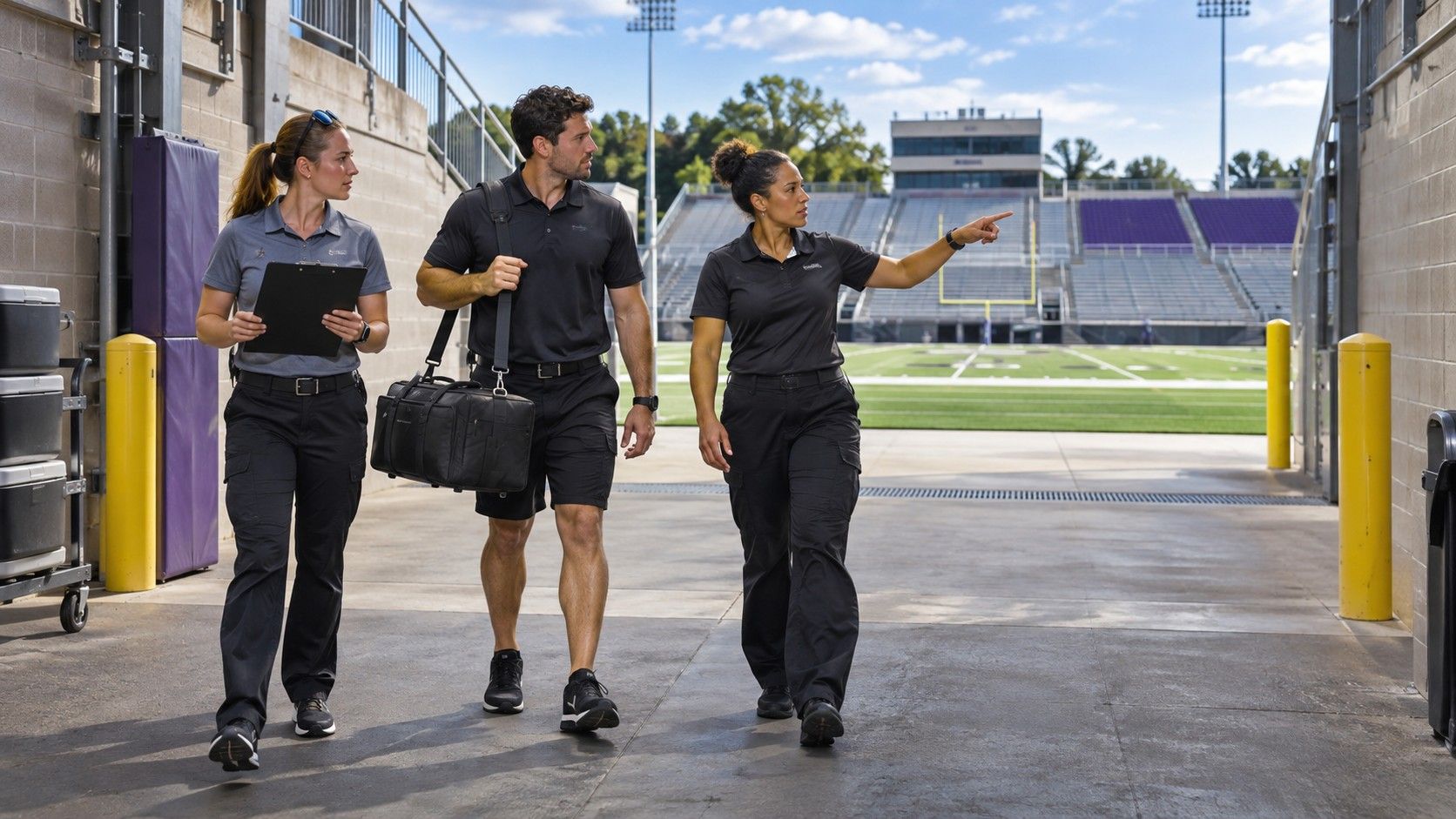
Original learning scenario: a team practices at a borrowed facility, and the plan names an entrance that is locked during the scheduled session. A useful correction verifies a usable access route and the arrangements needed to keep it available. Repeating the name of the locked entrance more clearly does not address the barrier. The proposed action should change the operational problem identified by the case.
Walk-through reasoning is helpful even in a written question. Imagine the path from recognition of an incident to arrival of the response team, using only the facts supplied. Where would a person need information, equipment or permission? This is not an invitation to invent hazards everywhere. It is a method for understanding why the stated obstacle matters to the plan.
Check equipment and communication
Availability means more than ownership. Equipment can be present but inaccessible, unmaintained or located where the assigned person cannot retrieve it promptly. Communication can be possible in theory but unreliable in the relevant area. A plan should include checks appropriate to the setting, with responsibility for identifying and reporting problems. In study questions, distinguish a resource list from evidence of readiness.
Consider a scenario in which staff know that a resource belongs to the facility but nobody knows where it is stored. Buying another copy may not be the most direct answer if the immediate gap is location and access. Another case might show a maintenance problem that cannot be fixed by relabeling the storage area. The correct reasoning follows the specific failure mode rather than applying one preferred solution to every resource question.
Communication arrangements need similar specificity. Who initiates contact, what information is conveyed and how is completion confirmed? A general instruction to call for help can leave uncertainty when several people assume that someone else is handling it. Evaluate whether the plan turns that intention into an assigned and rehearsed task. The exact process should follow current training and the venue's approved arrangements.
Assign roles and rehearsal tasks
Roles should be understandable to the people expected to perform them. A plan may require patient-focused responsibilities, communication, equipment retrieval, access management and direction of responders. The allocation depends on staffing and setting. Do not assume an unlimited team in an examination scenario, and do not assign a role that the described person cannot realistically carry out.
Rehearsal helps reveal conflicts between roles. One person may have been assigned two simultaneous tasks in different locations, or two people may each assume the other owns a task. A useful debrief identifies those conflicts and revises the arrangement. The goal is not to blame a participant for exposing the weakness. The rehearsal is valuable precisely because it makes an untested assumption visible before a real incident.
Confirmation matters when a task is critical to the sequence. A role assignment without a way to know whether it occurred may leave the team uncertain. In study rationales, explain how the proposed change reduces that uncertainty. Avoid claiming that a communication method guarantees a perfect response; it provides a more reliable process that still needs training, monitoring and review.
Evaluate a tabletop scenario
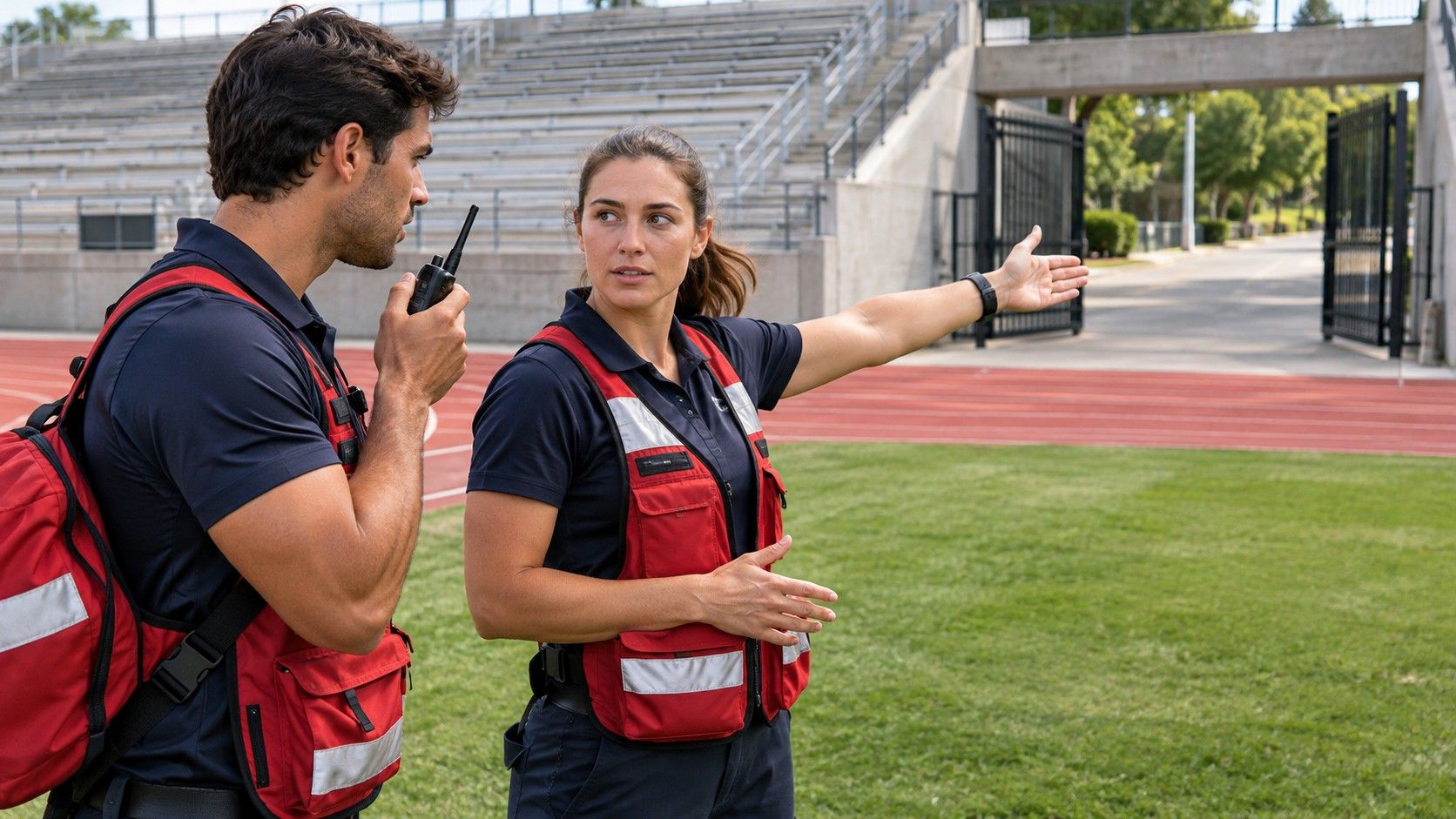
Original scenario: during a rehearsal, the person assigned to guide responders leaves the access point to search for equipment. Responders arrive but cannot find the correct route. Which revision most directly addresses the problem? A stronger answer would review the conflicting assignments and establish an operational allocation of access and equipment tasks. A vague reminder to move faster does not resolve the simultaneous responsibilities.
Now change the case so that roles are clear but the access route is blocked by a temporary barrier. The earlier staffing correction is no longer sufficient. The plan needs an accessible route and a process to identify location changes. This variation shows why an emergency-plan answer should be tied to the observed failure rather than memorized as a universal phrase about teamwork.
A tabletop exercise can ask participants to describe what they would do, while a practical rehearsal can test whether the route, communication and equipment arrangements actually work. These methods provide different kinds of evidence. A fluent verbal explanation does not prove that a locked door opens or that equipment can be reached. Match the check to the uncertainty you need to resolve.
Use a debrief to improve the plan
A useful debrief records the sequence, the delays or confusion and the change proposed for each significant issue. Give the change an owner and a way to verify it. If the action is to revise a route, confirm the route under the relevant conditions. If the action is to clarify a role, test whether participants can carry out the revised assignment. Completion of a meeting is not the same as completion of the improvement.
Keep incident information and learning records within the appropriate confidentiality and organizational processes. A student discussion should not reproduce identifying details from a real patient's emergency. Original fictional cases can teach the same system principles without exposing private information. When an actual event raises a concern, follow the designated supervisory and reporting pathway.
At the end of a study case, summarize the venue constraint, the affected task, the responsible role and the verification method. This makes the answer concrete enough to evaluate. It also distinguishes preparation, active response and later improvement, so that an otherwise sensible action is not selected at the wrong point in the scenario.