Critical incident questions compress a stressful situation into a small amount of text. Your task is to recognize the immediate priority, understand the available roles and avoid actions that delay a coordinated response. Use these educational scenarios to practice reasoning within current training and the relevant emergency action plan; they do not replace emergency instruction or authorize an unsupervised clinical response.
Read the setting and immediate threat
Start with the setting, the patient's apparent status and the decision requested. A question about the first priority differs from a question about documentation after the response. Identify whether the scenario describes an immediate threat, a communication failure or a later review issue. If several answers are generally sensible, the requested time point often separates the strongest response from an action that belongs later.
Do not let a dramatic mechanism distract you from the information actually provided. Equally, do not assume a reassuring finding that the case never states. A sound answer uses the available facts and recognizes when essential information is missing. Your study rationale should explain why a particular priority matters without inventing an exact protocol or treatment sequence beyond your current, verified training.
The environment can change the response. Access, noise, crowd movement, weather, equipment location and available personnel may influence how a plan is carried out. In a question, these details are useful when they affect the decision. Distinguish such operational facts from background description that merely makes the scenario readable. A concise case summary can keep your attention on the relevant conditions.
Activate the rehearsed response
An emergency action plan is useful when people understand how to activate it and what they are expected to do. A written document stored somewhere in the facility is not the same as an operational response. Questions may describe a plan that exists but has not been adapted or rehearsed at the current venue. In that case, the gap concerns implementation rather than the absence of a document title.
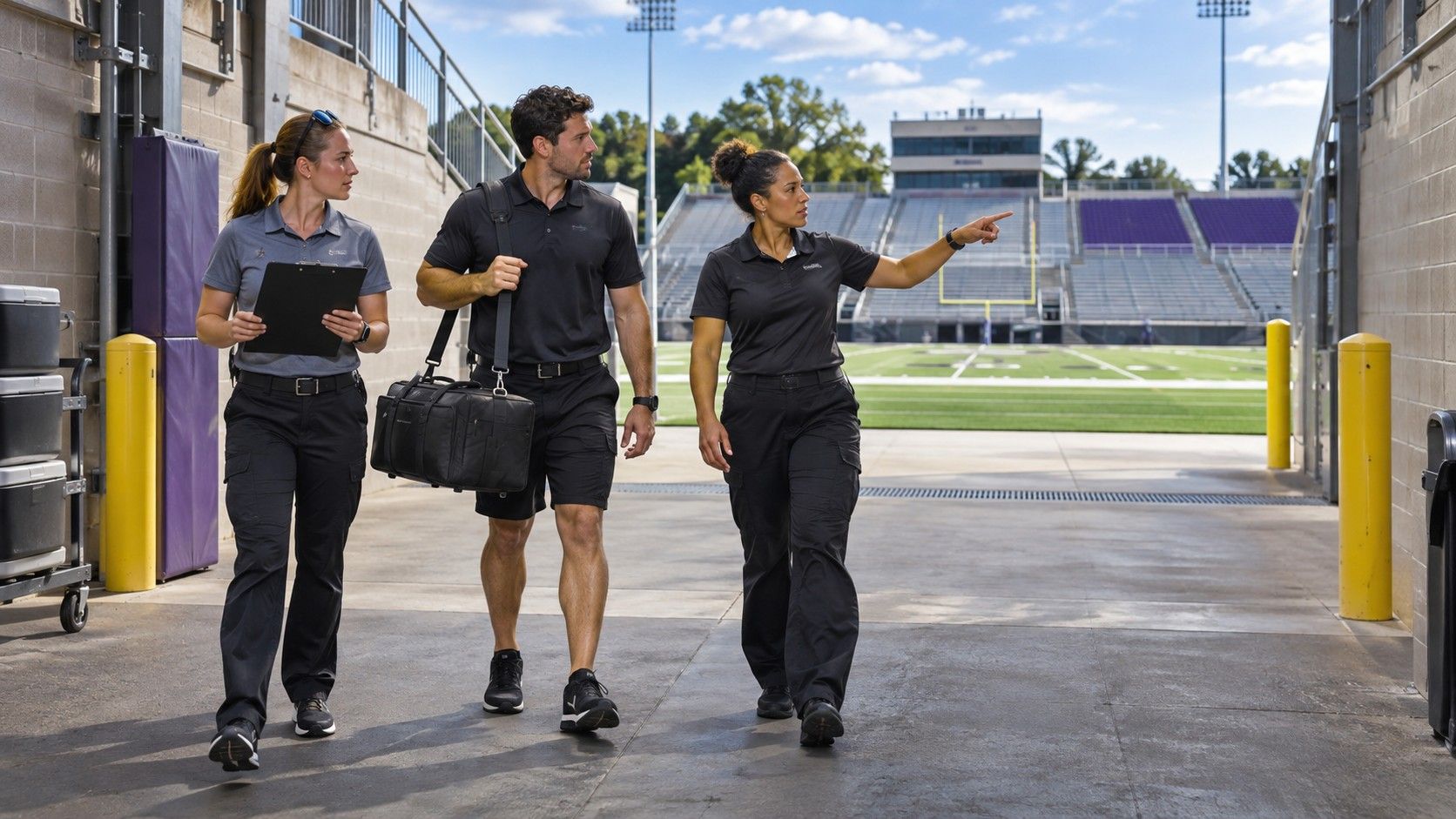
For an original practice scenario, imagine that a responding team reaches the facility but cannot find the designated entrance. The issue is not repaired by adding a general statement that emergencies are important. A stronger correction addresses location-specific directions, access and the person responsible for guiding responders. The explanation should connect each change to the delay observed in the case.
During study, separate immediate actions from preventive improvements. A rehearsal can identify missing roles before an incident, while an active emergency requires the current response to proceed according to training and available resources. An answer about rewriting the plan may be appropriate in a debrief but poorly timed during the event. Read verbs and time cues carefully before choosing.
Assign communication and access tasks
Role ambiguity can leave essential work undone even when several capable people are present. If everyone assumes another person has made a call or retrieved equipment, the team may discover the omission late. A useful assignment names a responsibility and includes a way to confirm that it was completed. This principle is more concrete than simply recommending better teamwork.
Original case: two staff members each believe the other is contacting emergency services. A third person begins repeating instructions without checking whether the call occurred. Which correction best addresses the system failure? An explicit communication assignment with confirmation targets the missing responsibility. Adding more voices without role clarity may increase confusion. The rationale should identify the unverified task rather than criticize individuals in vague terms.
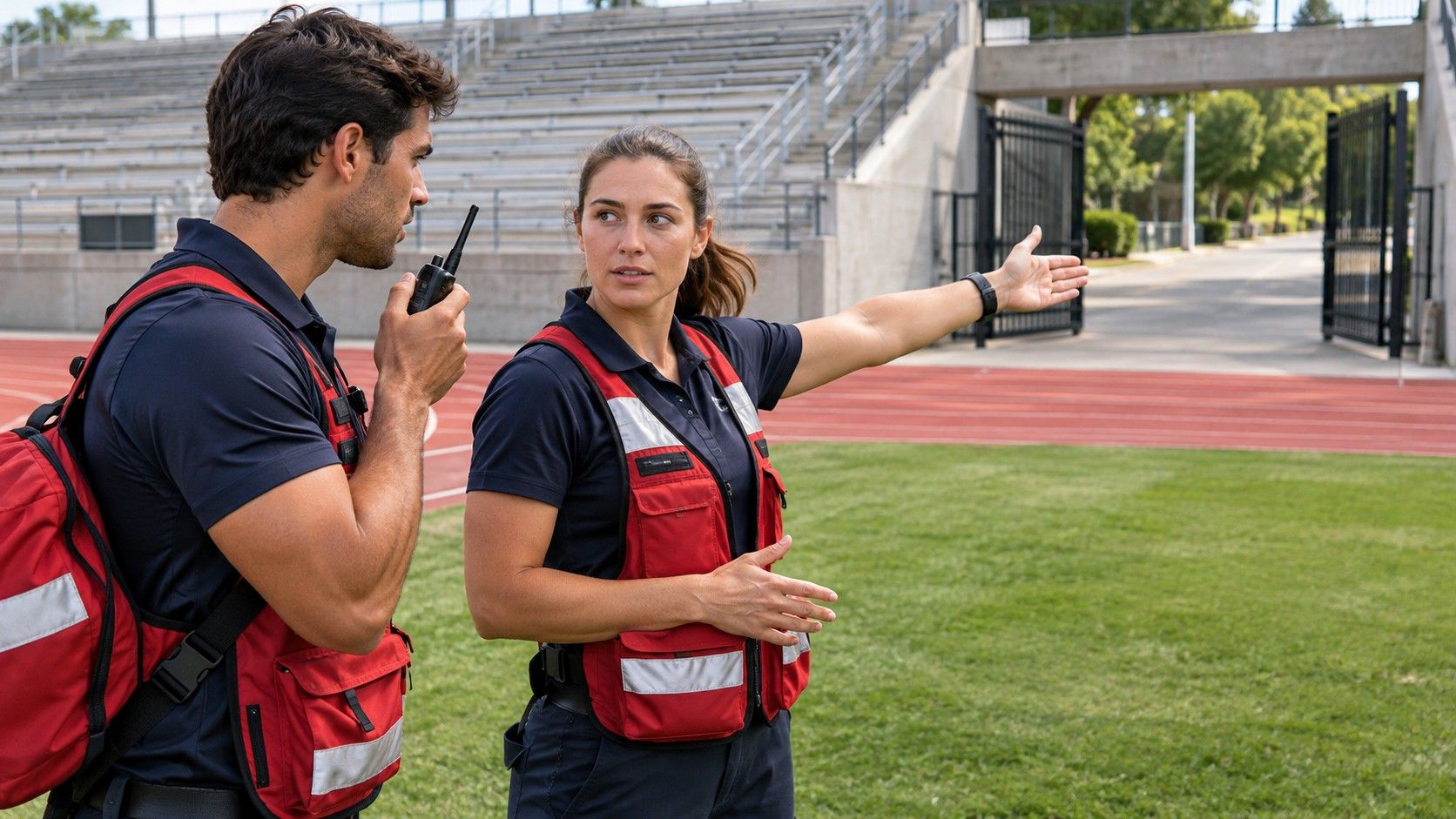
Access tasks also need ownership. Someone may need to manage a gate, direct responders or keep a route clear while others focus on the patient. The exact arrangement depends on the venue and staffing. In an examination question, do not assume an unlimited team or equipment that has not been supplied. Select the response that is operationally possible and consistent with the scenario's constraints.
Avoid unsafe shortcuts in scenarios
A familiar phrase can become a shortcut that bypasses the facts. For example, a candidate might choose an intervention because it appears in every emergency chapter, without checking whether it addresses this patient's status or the question's time point. Another might select an action outside their described role because it sounds decisive. Both errors confuse activity with an appropriate response.
Watch for answers that delay activation, abandon a necessary responsibility or assume that the situation will resolve without assessment. Also examine options that sound comprehensive but require unsupported information. The best explanation identifies the relevant principle and the limit of what can be concluded. A learning case should not be stretched into a detailed medical directive when the supplied information supports only recognition and escalation.
When reviewing a missed question, describe the shortcut you took. Did the injury mechanism capture your attention? Did you select a later action as the first step? Did you assume someone had completed a task? These are repairable reasoning habits. Practice with a changed setting so that you must identify the same principle under different surface details.
Debrief the system after the incident
A debrief asks what happened, what worked, where delays occurred and what should change. It should produce a specific improvement that can be checked at the next rehearsal. Statements such as communicate better are difficult to evaluate unless translated into roles, confirmation steps or access procedures. Keep the discussion factual and distinguish an observed process issue from speculation about blame.
Documentation and review should follow the relevant organizational and professional requirements. In study examples, protect confidentiality and avoid turning a real patient's event into an identifiable group exercise. You can practice with an original fictional scenario instead. If a clinical placement incident raises uncertainty, use the appropriate supervisory and reporting channels rather than treating an informal study discussion as the investigation.
Finish a case review by separating three layers: the immediate patient priority, the response-system tasks and the later learning process. An answer from the wrong layer can be reasonable in isolation but wrong for the question asked. Maintaining these layers helps you explain emergency reasoning clearly without reducing complex incidents to a memorized sequence of slogans.